
Zero-Waste Pattern Cutting: 5 Techniques for Designers


As the fashion industry grapples with its environmental impact, a wave of designers is stepping up to change the narrative. Zero-waste design is more than just a trend; it's a revolutionary approach to reducing the staggering amount of textile waste in landfills annually. These innovative creators are proving that sustainability and style can go hand in hand, crafting collections as mindful as beautiful. Let',s look at Zero-Waste Pattern Cutting: 5 Techniques for Designers
In this article, we'll introduce you to some pioneers of zero-waste, low-impact and sustainably made designs—individuals and brands who are reimagining every aspect of the design process. From pattern-making techniques that eliminate fabric waste to upcycling initiatives that give discarded materials a new lease of life, these designers are setting a bold example for the future of fashion. Whether you're a fashion professional, a conscious consumer, or simply intrigued by sustainable innovation, their stories will inspire and challenge you to view design from a fresh perspective and to actively support this transformative movement.
5 Core Zero Waste Techniques
Zero waste pattern cutting is one of those concepts that sounds technical — but at its core, it's a mindset shift more than a skill. It's the difference between starting with a body measurement and ending up with scraps, versus starting with a cloth panel and designing within it. Here are five techniques that form the foundation of zero-waste practice.
1. Jigsaw Patterning
Design pattern pieces that interlock like puzzle pieces. Rather than cutting shapes that leave gaps, you design the negative space intentionally — the gap between two pieces becomes the shape of a third. This technique rewards patience at the drafting stage, but pays off significantly at the cutting table.
Sketch pieces on a gridded layout before drafting
Look for shapes that 'nest' naturally into one another
Asymmetry is your friend — flipping a piece often creates a perfect fit
2. Geometric Modular Design
Limit your pattern shapes to basic geometric forms — rectangles, squares, triangles. These tiles together mathematically without gaps, making them among the most efficient shapes for zero-waste cutting. Many zero-waste designers work almost exclusively in rectangles, then use design details like pleating, gathering, and seaming to create shape and silhouette.
Rectangles and squares leave virtually zero waste on most woven fabrics
Triangles can be planned in pairs to form rectangles in the layout
Save circles for accent pieces — pockets, yokes, appliqué — and plan their offcuts
3. Draping & Zero Seam Construction
Work directly on the body or dress form using the full fabric width as a continuous surface. Rather than cutting pieces and seaming them together, you fold, pleat, wrap, and pin — cutting only where absolutely necessary. This approach draws on centuries-old traditions found in garments such as the sari and kimono and is particularly effective for draped, fluid silhouettes.
Cut only at the neckline and armhole — wrap or pleat everywhere else
Folds and pleats create structure without additional seam allowance waste
Best suited to knits, jerseys, voiles, and loosely woven fabrics
4. Seam-as-Design Integration
Instead of treating seams as a necessary construction detail, treat them as an aesthetic choice. Place seams where offcuts would naturally occur and make them a visible, intentional feature of the design. This turns a potential waste point into a design signature.
Panel seams that absorb irregular cuts and become part of the silhouette
Color-blocking built from contrasting offcuts rather than planned yardage
Patchwork sections designed from predicted leftover fabric — planned from the start, not improvised
5. Whole Cloth Design
Flip the conventional approach entirely: instead of starting with a design and buying fabric to suit it, start with the fabric panel and build the design around its dimensions. The cloth — its width, length, and weight — becomes the design brief. Hemlines, sleeve lengths, and widths are determined by the fabric.
Map the full bolt width and usable length before drafting a single piece
Design the silhouette within the fabric's dimensions, not the other way around
This approach often produces the most original, constraint-driven design decisions
PATTERN LAYOUT STRATEGIES — QUICK REFERENCE
Even with conventional pattern pieces, how you arrange them on fabric dramatically affects how much you waste. Pair any of the 5 techniques above with these layout strategies for maximum efficiency.
Strategy | How It Works | Best For |
Nesting | Rotate and flip pieces to fill gaps between larger pattern parts | Bodices, sleeves, curved pieces |
Width Mapping | Draft pieces to match exact fabric width so offcuts are eliminated at the edge | Trousers, skirts, structured pieces |
Flip & Mirror | Mirror asymmetric pieces so they share a cut line, saving a full seam allowance width | Collars, cuffs, facings |
Offcut Scheduling | Plan small pieces — pockets, loops, belt tabs — to fill gaps you can predict from the layout | Any style with details |
Grade Stepping | Nest multiple sizes across one layout, cutting each size from planned fabric zones | Small production runs |
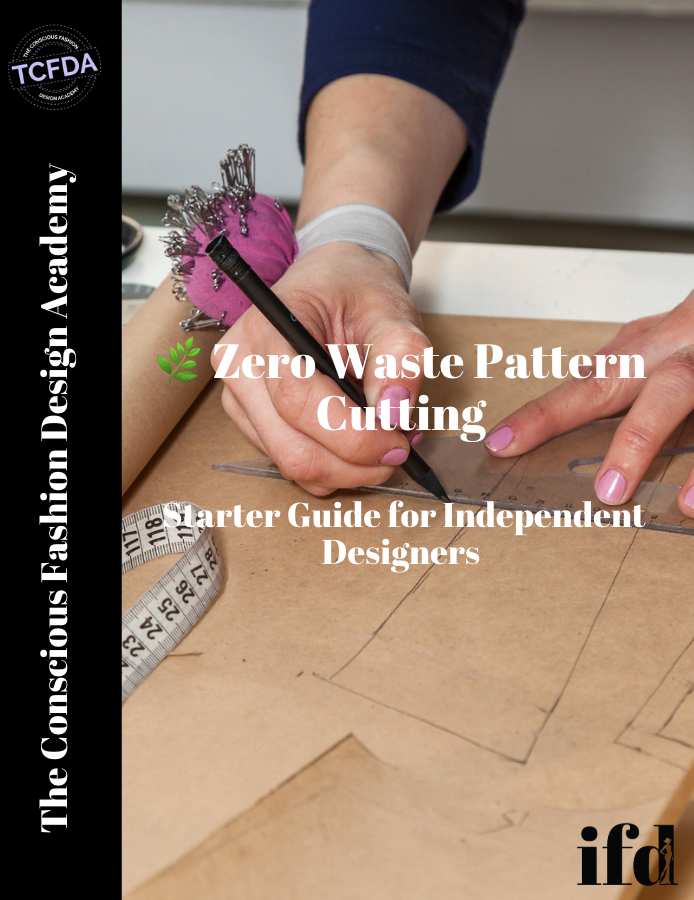
Want a reference you can keep at your cutting table? This free PDF covers everything in this post, plus a printable step-by-step checklist for before, during, and after every cut. Enter your email below, and we'll send it straight to your inbox.
Your printable guide to the 5 core techniques, pattern layout strategies, and a cutting-table checklist — all in one place.
Explore how zero-waste designers are shaping a more responsible, thoughtful, and creative fashion industry.

1. Zero Waste Daniel
Zero Waste Daniel — New York City
Daniel Silverstein is one of the most recognized names in zero-waste fashion. Brooklyn-based and relentlessly creative, he uses his signature "ReRoll" technique to join pre-consumer fabric scraps and sew them into new fabric, creating patchwork-style, genderless garments that send nothing to landfill. His work first went viral in 2017, and he has since collaborated with Nuuly, Alice + Olivia, ThredUp, and even the NYC Department of Sanitation. In 2025 he launched a limited-edition Golden Girls capsule collection, showing that zero waste fashion can be playful, cultural, and commercially exciting all at once.
Learn more at:: zerowastedaniel.com


2. Charlotte Bialas — Paris
Paris-based Charlotte Bialas is known for her use of vintage textiles sourced from top French fashion houses, combined with zero-waste geometric cutting to minimize fabric waste. Her collections carry a distinctive retro elegance, and any remaining scraps are repurposed into accessories — bags, necklaces, and other pieces — ensuring nothing is wasted throughout the collection.


3. Dr. Mark Liu — Academic & Practice
Dr. Mark Liu's work sits at the intersection of mathematics and fashion. Known for his concept of "Non-Euclidean Fashion Pattern Making," he applies advanced geometric principles to traditional pattern cutting to eliminate textile waste entirely. His couture pieces are as much scientific exploration as they are garments — and a compelling example of what happens when design and research fully converge. Learn more about his innovative work here.

The following designers are zero-waste/low-waste material sourcing brands, not specifically Zer0-waste patterning methods
4. Christy Dawn — Los Angeles
Christy Dawn has evolved from a deadstock-focused brand into one of the most compelling farm-to-closet stories in sustainable fashion. Rather than simply using leftover fabrics, the brand now works directly with regenerative cotton farms — meaning the materials they use actively restore soil health and biodiversity. Their designs are bohemian and timeless, and they operate both a physical store in Los Angeles and a pre-loved marketplace for their own garments, extending each piece's life beyond its first owner.

5. Anekdot — Berlin
Berlin-based Anekdot creates lingerie, loungewear, and swimwear from pre-consumer textile waste and regenerated synthetics like ECONYL® — a yarn made from recovered fishing nets and other nylon waste. Their small-scale, local production model means every piece is traceable, and their one-of-a-kind approach means no two garments are exactly alike. Find Anekdot’s collections here.

6. Whimsy + Row
This Los Angeles-based brand produces zero-waste clothing in small batches using eco-friendly materials like organic cotton, linen, and Tencel. They repurpose fabric scraps into accessories like scrunchies and use recyclable shipping materials. Visit Whimsy + Row here.

7. RE/DONE
RE/DONE started as a brand revamping vintage Levi's jeans into modern fits — and has grown into a broader upcycled label that partners with other brands to give archived inventory new life. Their collaborations with Hanes and Champion have introduced zero-waste thinking at a larger commercial scale, showing that upcycling doesn't have to mean niche or limited. Check outRE/DONE here.
A Call to Action for a Zero Waste Future
The work of zero-waste designers is a powerful reminder that fashion can be both innovative and sustainable. By prioritizing creativity, resourcefulness, and environmental stewardship, they are proving that it's possible to reimagine an industry often criticized for its wastefulness. But the journey doesn't stop with them—it's a collective effort. The time to act is now. Whether you're a designer, a brand, or a consumer, we all have a role in supporting and advocating for zero-waste practices. Together, we can drive the industry toward a more sustainable future where every thread counts and nothing goes to waste. Let's champion these pioneers and make zero waste the new standard in fashion.
Looking to grow your skills and knowledge to transform your work? Whether you are a start-up, experienced designer, or working at the corporate level, we have courses to fit your needs, including how to design consciously- check out our curriculum here (and check back often as we upload our class offerings!)
Like this article? Please share! We appreciate your support of our work here at Inside Fashion Design. Have a comment? Leave us a note! Have an idea for an article or a favorite brand you want us to feature?
Send us a note! Design@insidefashiondesign.net
Sources
1. 15% of fabric is wasted on the cutting room floor — Timo Rissanen / Edge Expo — 'The Waste on the Cutting Room Floor.'
2. 10–15% of fabric wasted in cut-and-sew; experts suggest the figure may be higher — UC Santa Barbara Bren School — 'Cut-and-Sew Textile Waste within the Apparel Supply Chain' (2024)
3. The fashion industry generates 92 million tonnes of textile waste annually — United Nations Environment Program (UNEP) — International Day of Zero Waste 2025
4. 92 million tonnes of textile waste — additional reference — Earth.Org — '10 Concerning Fast Fashion Waste Statistics'
5. Historical zero-waste garments: kimono, sari, and ancient draped forms — Textile School — 'Zero-Waste Textile Design: Revolutionizing Sustainable Fashion' (2025)
6. Foundational reading on zero waste pattern cutting techniques — Rissanen, T. & McQuillan, H. — Zero Waste Fashion Design (Bloomsbury/Fairchild Books, 2016)


Finding a straightforward article on this subject was not as easy as I expected. I am glad I came across this one because it helped clarify a few things for me. After reading it, I also decided to check DigitalSuits Squarespace to Shopify migration services and learn more about them.
我比較在意名字是否順口,所以用了 起名網 的工具看看。分析結果包含發音和字形搭配,看完之後很容易比較不同名字的優缺點。
This was one of those posts that stayed clear from beginning to end without becoming repetitive. The examples fit naturally with the explanation, which made it easier to understand the overall idea. I happened to come across review matrix calculator afterward while reading a few related pages, and it seemed connected to the discussion here. I'd be curious to see another article that compares a few different methods side by side.
This article was a pleasant surprise because it covered the topic in a simple and logical way. I had been searching for trustworthy explanations. I also decided to explore the guide Best Crypto Exchanges for Institutions , and it was definitely worth my time.
Zero-waste fashion sounds responsible, but the average shopper still asks a simple question first: can I actually wear this without feeling awkward? When shoes enter that conversation, shoemall makes sense only if sizing, comfort, and returns are clear enough. I have bought “sustainable-looking” pieces that felt good in theory and wrong the second I tried to build an outfit around them. Waste matters, but so does wearability. A garment sitting untouched in a closet is not really a better choice.